The prompt-first pass
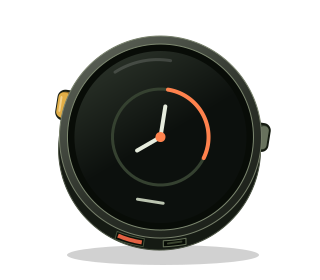
The original build below records how this idea first worked. The durable lesson now targets the M5Stack Stopwatch and lives in the prompt, behavior contract, generalized tests, and hand-review checklist. Generated firmware is evidence for those sources, not the source itself.
This lesson was originally slotted eleven days earlier, right after the first ESP-NOW day, and it kept getting pushed back — correctly, it turns out. Trivia looked simple and was actually five lessons in a trenchcoat: packet design, game state sync, input grammar, feedback cues, and a fairness problem. By day 30, four of the five were already on the shelf.
The capstone wrote itself out of parts.
Fairness is a field, not a feature
The one genuinely new idea is in the answer packet: the player’s own millis() at the moment of the press.
With a single buzzer it’s trivia trivia — a number on the host’s screen. But the whole design of a buzz-in game collapses if arrival time decides ties: radio retries, channel contention, one board’s Wi-Fi task having a moment — all of it becomes gameplay. Stamping the press at the source moves the race from the network to the thumbs, where it belongs. Multi-buzzer ranking becomes a sort on data the protocol already carries.
Fairness cost four bytes. Most fairness does, if you design it in before you need it.
The deck audits the month
Writing original true/false statements beat licensing someone’s question bank, and the deck became a self-referential exam: Bluetooth Classic works on the ESP32-S3 (false — the iPod died for this), a 5 ms FreeRTOS delay rounds to zero at 100 Hz (true — day 24’s watchdog has the scars), AMOLED screens need a backlight (false — day 1 learned it the hard way). A trivia deck that teaches the course it ships with.
The game that played itself
The verification run is the series’ thesis in one transcript: a script advanced the host’s deck over one serial port, answered on the buzzer’s pushers-by-proxy over the other, and injected exactly two wrong answers. Final score: 10 of 12. Twelve questions, twelve rulings, twelve verdicts, two brands, two frameworks, zero humans — and the two errors were the two the script chose.
When the mistakes are machine-verified, the game logic is done.
What we learned
- Capstones compose; they don’t introduce. Four of five subsystems came off the shelf, and it showed in the build time.
- Fairness is cheapest at design time. One timestamp field future-proofs the entire multi-buzzer problem.
- Write your own deck. Original questions dodge licensing and — better — get to teach the course they belong to.
- Verify the errors. A test that only proves success proves half; injecting known wrongs proves the ruling.