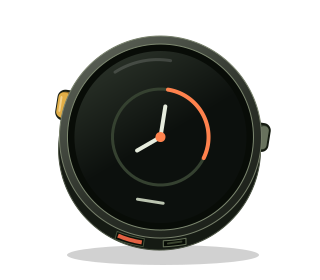
The prompt-first pass
The original build below records how this idea first worked. The durable lesson now targets the M5Stack Stopwatch and lives in the prompt, behavior contract, generalized tests, and hand-review checklist. Generated firmware is evidence for those sources, not the source itself.
The plan for this day once said “LVGL keyboard.” Sixty-some keys on a 1.75-inch circle, hunt-and-peck with a fingertip, to capture a thought before it evaporates. The redesign happened the moment day 28 worked: if the device can hear, the keyboard is a skeuomorph.
Hold the crown. Say the thought. It files itself.
A moment, not a stream
Captions and memos both turn speech to text, but they disagree about when. Captions are a stream — words wanted mid-sentence, interims and finals, a socket held open forever. A memo is a moment — nobody needs the transcript until the thought is finished.
That distinction picked the architecture: record the whole clip to PSRAM, then one POST to Deepgram’s prerecorded endpoint. No WebSocket, no interim states, no jitter thinking. Thirty seconds of 8 kHz mono is 480 KB — the PSRAM that day 10 spent on a bubble sprite holds half a minute of your voice without noticing.
And the pipeline blocks, on purpose.
Two seconds of transcribing... → saving... after release is not lag to hide; it’s the receipt printing.
The month’s instruments kept learning to show their state by name — this one narrates its whole assembly line.
The paperwork files its excuses too
A device that silently eats memos is worse than no device — you trusted it with the thought. So every failure mode surfaces with its name: the HTTP code from Deepgram, the missing config, the sub-half-second press discarded as pocket noise. The one weakness v1 accepts, and the README admits: a dead network at release time loses the memo. The fix (queue clips in NVS, retry later) is designed but not built — day 13’s rule about never promising rollback you don’t have applies to promises about durability too.
The backend audition that ended at home
This day auditioned more backends than any other: Memos (self-hosted, honest), Notion (everyone has it), Telegram (free forever, notes arrive on your phone), Discord webhooks, a self-built Worker on Cloudflare D1 — and Apple Notes, the one actually in daily use here, which has no API at all and would need a Mac running AppleScript as its bridge.
The decision was none of them, for now: local first.
Twenty NVS slots, a cursor, and the B pusher browsing newest-first.
A note dictated on a walk shouldn’t depend on a server being reachable, and a device that is complete by itself is a better v1 than any integration.
The audition list survives in the README as extended options, each one saveNote function away — and the eventual Apple Notes bridge is the best story of the bunch, so it will probably happen.
Reconfiguration is a chord now
The first portal only opened when no credentials existed, which quietly meant reconfiguring Wi-Fi required a computer. The fix shipped to every StopWatch network day at once: hold both pushers two seconds, credentials clear, the portal reopens. Day 11’s chord grammar, now doing infrastructure work.
What we learned
- Keyboards are a fallback, not a default. On a device that hears, hold-and-speak beats hunt-and-peck by a category.
- Local first, integrations second. A complete device beats a connected one; the cloud list keeps as options.
- Moments and streams are different architectures. Batch the memo; stream the caption; don’t confuse the two.
- Blocking is honest when the user is waiting anyway. Narrate the pipeline instead of hiding it.
- Trust requires named failures. A note-taker’s worst bug is a silent shrug.