The assignment
Turn nearby public aircraft data into a readable round radar without hiding stale or missing fields.
The durable source is this prompt, SPEC.md, the machine-readable contract, and its layered acceptance criteria. Generated firmware is a disposable candidate.
Reference frame
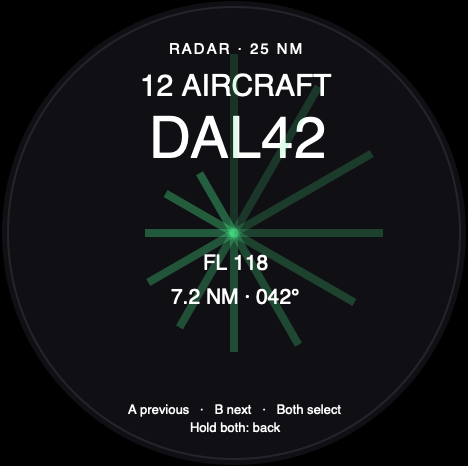
This is a deterministic screenshot of the visual acceptance model. It defines the intended hierarchy and safe-area use; only a later framebuffer capture from the attached Stopwatch can count as device rendering evidence.
The build prompt
Build ESPtember Day 26: Flight Radar for the M5Stack Stopwatch Dev Kit (C152).

Read these before writing code:
- .agents/skills/build-stopwatch-lessons/SKILL.md
- .agents/skills/prompt-first-embedded-lessons/SKILL.md
- days/day-07-touch-calibration/SPEC.md
- days/day-26-flight-radar/SPEC.md
- days/day-26-flight-radar/tests/contract.json

Treat the prompt, spec, tests, and acceptance criteria as source.
Put deterministic behavior in a portable core and keep Arduino, LVGL, M5Unified, storage, network, audio, and sensor adapters outside it.
Run scripts/prompt-contract/validate_day.sh days/day-26-flight-radar before compiling a device candidate.
Do not edit the contract or tests to make a candidate pass.

Hardware and shared platform

- Target board_M5StopWatch on ESP32-S3 with OPI PSRAM.
- Hold the device with the lanyard loop at the bottom: BtnA is physical left and BtnB is physical right.
- Immediately after M5.begin(), set panel width 468, height 466, offset_x 6, offset_y 0, then rotation 0.
- Never draw rows 466 or 467. Keep focus decoration inset and every interactive bound inside the round safe area.
- Load Preferences namespace espt-touch, blob key record, after display setup and before touch input.
- Accept and validate Day 07 version 1 and version 2 records. Read raw touch, apply the complete shared warp, clamp once, then feed the mapped point to the application.
- Provide the shared runtime calibration entry path. App-only installation must preserve the record.
- Allocate retained frames and large working buffers in PSRAM; fail visibly and over serial when required hardware or memory is unavailable.

Controls

Use the default grammar: BtnA/left is Previous or Decrease; BtnB/right is Next or Increase; short both is Enter; hold both for 600 ms is Back. Preserve the 80 ms join and overlap rules and consume chord clicks.
Touch must dispatch the same semantic actions as physical controls.

Lesson behavior

- Fetch aircraft around a configured location and radius over TLS; parse only callsign, lat, lon, altitude, and track.
- Project distance and bearing onto a circular scope, cap targets deterministically, and mark data age.
- Left and right select visible aircraft; Enter opens details; Back returns to the scope.
- Refresh every eight seconds with bounded timeouts and keep the last valid frame visibly stale on failure.
- Reject impossible coordinates and sanitize callsigns before display or logs.

Diagnostics and acceptance

- Prefix serial protocol lines with D26_ and implement status, reset, action, capture, and touchlog commands.
- Report hardware identity, corrected geometry, touch-map version and generation, current portable state, memory headroom, and last named error.
- Injected actions must use the same reducer, hit testing, callbacks, and control recognizer as physical input.
- Retain the exact RGB565 pixels sent to M5GFX and stream captures in bounded chunks without blocking the watchdog.
- Run every scenario in tests/contract.json, generated deterministic sequences, the deliberate mutation, and the lesson-specific checks in SPEC.md.
- Complete 20 largest-state round trips without reset or growing heap/PSRAM use.
- Confirm the active touch-map version and generation remain unchanged.
- Physically review touch alignment, BtnA/BtnB direction, chord behavior, cues, clipping, lower-edge use, and the absence of a black bar.

Record host, compile, injected-device, and physical evidence separately.
Never describe reference rendering or injected input as physical proof.
Required behavior
- Fetch aircraft around a configured location and radius over TLS; parse only callsign, lat, lon, altitude, and track.
- Project distance and bearing onto a circular scope, cap targets deterministically, and mark data age.
- Left and right select visible aircraft; Enter opens details; Back returns to the scope.
- Refresh every eight seconds with bounded timeouts and keep the last valid frame visibly stale on failure.
- Reject impossible coordinates and sanitize callsigns before display or logs.
Recorded evidence
The shared contract runner validates Stopwatch geometry, touch-map ownership, control metadata, state types and ranges, deterministic scenarios, round-face control bounds, and 10,000 generated actions against three disposable reducer shapes. A deliberately mutated reducer must fail.
Historical implementation evidence from before the prompt-first Stopwatch migration follows.
Recorded evidence · September 22, 2026: The firmware boot and provisioning states were verified over serial; the exact endpoint the firmware calls was verified live from the host during development (12 aircraft within 25 nm of the default coordinates at time of check). The on-device fetch awaits Wi-Fi credentials on the bench, noted in NOTES.md.
The reference screenshot is acceptance-model evidence. The next hardware pass must replace or supplement it with a framebuffer capture and a hand-review record.