The prompt-first pass
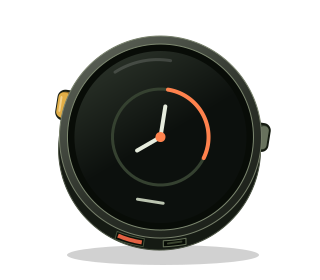
The original build below records how this idea first worked. The durable lesson now targets the M5Stack Stopwatch and lives in the prompt, behavior contract, generalized tests, and hand-review checklist. Generated firmware is evidence for those sources, not the source itself.
Day 19 built the clock that speaks. Day 20 builds the ear that listens back — and the two verify each other, which is the real reason they shipped as a pair.
Beats are edges, not sounds
The first instinct is spectral: FFT the music, find the beat in the frequencies. But a beat isn’t a frequency — it’s an event, a sudden rise in energy against what came before. The detector is therefore two numbers: a fast one (this frame’s RMS) and a slow one (a 2% running average), and an onset is the fast crossing 1.8× the slow.
The refractory window does the quiet heavy lifting. A snare hit is not one energy spike; it’s a burst that would read as three onsets 40 ms apart and wreck every gap measurement downstream. Declaring 220 ms of deafness after each onset costs nothing musically — 240 BPM is still detectable — and buys clean intervals.
The octave problem is unsolvable, so say so
Fold every gap into 250–1500 ms and the estimator becomes robust to missed beats and double-counts — and permanently blind to the difference between 60 and 120 BPM. Every beat tracker in existence fights this; the honest ones admit the ambiguity instead of guessing. This one folds, reports, and lets the confidence bar say how sure while the human supplies the octave.
Confidence itself is the day’s best interface idea, borrowed from day 15’s honesty streak: the fraction of gaps agreeing with the median. Music scores high. Conversation, keyboard clatter, a passing truck — the onsets fire, but the gaps agree on nothing, and the bar stays low. The instrument knows when it doesn’t know.
The pair validates itself
The verification plan needs no reference gear: set day 19 clicking at 120 on one board, point day 20 at it from the other. If the checker reads the metronome’s number, both instruments are right; if not, at least one is lying, and the disagreement localizes the bug. Instruments in pairs audit each other — the same trick as the walkie-talkie’s two transports, applied to time.
What we learned
- Beats are edges. A fast average crossing a slow one finds rhythm better than any spectrum.
- Refractory windows clean the data at the source. 220 ms of deafness beats any amount of downstream filtering.
- Fold, then admit it. The octave ambiguity is structural; honest instruments report it instead of guessing.
- Confidence is an output. The fraction-in-agreement number turns “a BPM” into “a BPM you may trust.”